Laser Therapy
Focused Light for Pain Relief & Recovery
Class IV laser therapy is a noninvasive treatment that uses focused therapeutic light to help manage pain, reduce inflammation, and support tissue recovery.
Photobiomodulation
Light to Support Pain Relief, Recovery & Healing
At Rochester Clinic, laser therapy may be used for selected musculoskeletal conditions, either independently or alongside rehabilitation, orthotics, and other appropriate treatments.
At Rochester Clinic, we use two complementary forms of photobiomodulation: Class IV Laser Therapy for focused, higher-power treatment in the clinic, and Red & Near-Infrared Light Therapy for broader, lower-intensity treatment that can be used more frequently and, when appropriate, continued at home.
Rather than choosing one or the other, they can be used together: focused treatment in the clinic with broader, ongoing support between visits.
What Photobiomodulation Means
- Photo= Light
- Bio= Living tissue
- Modulation= Influencing how something functions
Photobiomodulation means using light to influence biological activity. Unlike surgical lasers that cut or remove tissue, PBM delivers selected wavelengths of light without intentionally damaging it.
How It Works
How Does Class IV Laser Work?
Class IV Laser Therapy uses photobiomodulation (PBM) to influence cellular activity involved in pain signaling, inflammation, and tissue repair. Results vary by condition and treatment protocol.
Light → Cellular Signaling → Recovery & Function
Two Ways to Deliver PBM
Focused in the Clinic. Broader Between Visits.
Focused · Higher Power · In-Office
Class IV Laser Therapy
Concentrated light for a specific treatment area.
Class IV therapeutic laser delivers concentrated light energy to a targeted area. Its higher power allows a therapeutic amount of light energy to be delivered relatively quickly to tissues such as a joint, tendon, plantar fascia, or muscle. Some patients notice improvement in pain or movement soon after treatment, though the response varies by individual and condition. Because Class IV lasers require safety precautions, treatments are performed in the clinic by trained personnel.
May be considered for
- Acute and chronic musculoskeletal pain
- Plantar fasciitis and heel pain
- Tendon and muscle injuries
- Arthritis and joint pain
- Sprains and soft-tissue injuries
- Sports and overuse injuries
- Selected nerve-related conditions
- Recovery following injury
Broader · Lower Intensity · More Frequent
Red & Near-Infrared Light Therapy
Broader coverage at a lower intensity.
Red and near-infrared light therapy typically uses LEDs to deliver photobiomodulation over a larger area at a lower intensity than our Class IV laser. Instead of concentrating higher power on a small target, it can expose a broader region such as the foot and ankle, lower leg, hand, or surrounding muscles. Its lower intensity and broader coverage make it useful when more frequent treatments are desired. For appropriately selected patients, treatment may also continue at home between office visits using a suitable device and recommended protocol.
May be considered for
- Ongoing pain management
- Muscle and tissue recovery
- Arthritis and joint health
- Tendon and overuse conditions
- Selected neuropathy-related symptoms
- Selected wound-healing applications
- Exercise and activity recovery
- Ongoing recovery and maintenance
What Do Class II and Class IV Mean?
These terms can be confusing because "Class II" and "Class IV" may describe different classification systems.
Class IV Laser refers to the laser's safety classification, which is related to its output and potential hazards. Because of the higher output, appropriate eye protection, training, and safety procedures are required, which is one reason our Class IV laser is an in-office treatment.
Class II Medical Device refers to the device's FDA regulatory classification, not the intensity of its light in comparison with a Class IV laser. FDA Class II medical device ≠ Class II laser. They are different classification systems and should not be directly compared.
Focused Treatment + Broader Ongoing Support
Why Use Class IV Laser and Red Light Together?
They use the same general principle, photobiomodulation, but deliver light differently.
They use the same general principle, photobiomodulation, but deliver light differently.
Explore Red Light TherapyStart Focused. Continue Broadly.
For example, a patient with significant heel, ankle, or joint pain may begin with targeted Class IV laser therapy in the clinic. Red and near-infrared light can then provide broader, more frequent PBM between visits and, when appropriate, may be continued at home.
Class IV Laser
Focused · Higher Power · In-Office
Red + Near-Infrared
Broader · Lower Intensity · More Frequent
Home PBM
Ongoing Support · Recovery · Maintenance
The goal is not simply more treatment. It is to use the appropriate light, dose, treatment area, and frequency for each stage of care.
Selected Conditions
What Conditions May Benefit?
Class IV laser therapy may be considered for selected conditions, including:
- Plantar fasciitis and heel pain
- Achilles tendinopathy and tendon injuries
- Muscle and ligament injuries
- Arthritis and joint pain
- Sprains and overuse injuries
- Selected chronic musculoskeletal pain conditions
The Right Dose. The Right Timing. The Right Treatment Plan.
It’s Not Just the Laser. It’s How We Use It.
We consider your condition, biomechanics, activity level, and recovery goals to personalize treatment. Laser therapy may be used alone or alongside rehabilitation, orthotics, and other appropriate care.
What to Expect
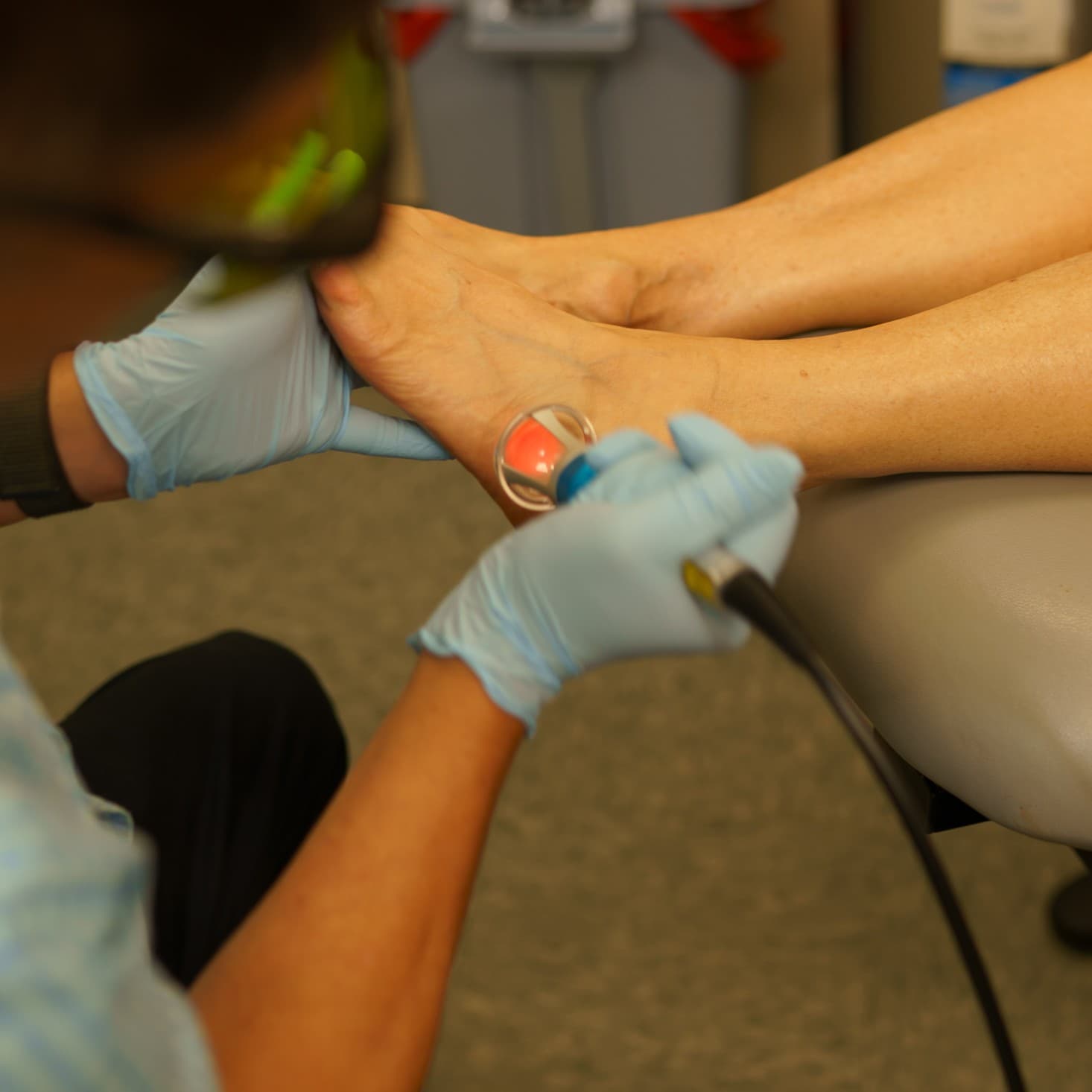
Treatment involves applying a handheld laser to the affected area. Sessions are generally brief, noninvasive, and require appropriate eye protection. Treatment frequency depends on your condition and response.
Where PBM Fits
Light Therapy Is One Part of the Bigger Picture
Pain does not always mean that the painful tissue simply needs more treatment. Laser may help relieve heel pain, but abnormal loading, tight muscles, weakness, footwear, activity, nerve irritation, metabolic health, or other factors may continue to contribute. That is why we integrate PBM into Rochester Clinic's broader approach to care.
Relieve
Class IV laser may provide focused treatment to help reduce pain and improve comfort and movement.
Understand
We evaluate biomechanics, movement, joint function, nerve involvement, activity, inflammation, overall health, and other contributing factors.
Restore
Class IV laser and red/NIR light may support recovery while other treatments address strength, flexibility, biomechanics, lifestyle, and other factors.
Prevent
Exercise, appropriate footwear or orthotics, Lifestyle Medicine, and home PBM when appropriate may help maintain function and reduce recurrence.
More Than Light Therapy
Photobiomodulation Works Best as Part of a Plan
Depending on your condition and goals, PBM may be combined with:
Biomechanics & Movement
Custom orthotics, footwear, offloading, and movement correction.
Exercise & Rehabilitation
Strength, flexibility, balance, and mobility.
Regenerative Medicine
Regenerative treatments when clinically appropriate.
Lifestyle Medicine
Nutrition, physical activity, sleep, stress management, and metabolic health.
Medical Care
Diagnosis, imaging, medications, injections, and coordination with other healthcare professionals.
Looking Ahead
What About Shockwave Therapy?
Photobiomodulation uses light energy. Shockwave therapy uses mechanical/acoustic energy. They produce different biological stimuli and may be complementary for selected musculoskeletal conditions, so we would not present shockwave as a type of PBM. Eventually, both can sit under a broader heading.
Photobiomodulation
Class IV Laser · Red & Near-Infrared Light
Shockwave Therapy
Mechanical/acoustic stimulation for selected tendon, fascia, muscle, and musculoskeletal conditions.
Advanced Non-Surgical Therapies
Photobiomodulation · Shockwave Therapy · Regenerative Medicine. Different tools, one comprehensive treatment strategy.
Targeted Treatment. Personalized Recovery.
Whether you’re dealing with persistent heel pain, tendon problems, arthritis, or an injury that has been slow to improve, we’ll help determine whether Class IV laser therapy is an appropriate option.
Ask whether photobiomodulation is right for your condition.